
Avascular necrosis of the hip is a condition that many patients have never heard of until they receive the diagnosis — and it often comes as a shock. You may have been living with hip pain that you attributed to a muscle strain or arthritis, only to discover the actual cause is bone death from loss of blood supply.
The most crucial thing to understand is this: AVN of the hip is treatable — and the right treatment at the right stage can restore your quality of life significantly. This complete guide explains what AVN is, when surgery becomes necessary, and what you can realistically expect from AVN hip replacement.
What Is AVN of the Hip?
Avascular necrosis (AVN) — also called osteonecrosis — is a condition where the bone tissue in the femoral head (the ball at the top of the thigh bone) begins to die due to a disruption in its blood supply.
Without adequate blood flow, bone cells cannot survive. Over time, the affected area of bone weakens, and the femoral head — which bears the full load of your body weight — eventually collapses. Once collapse occurs, the smooth cartilage surface of the hip joint is destroyed, producing severe pain and significant loss of hip function.
AVN can progress rapidly — sometimes from early-stage disease to femoral head collapse within months — which makes early diagnosis and timely treatment decisions absolutely crucial.
What Causes AVN of the Hip?
AVN develops when blood supply to the femoral head is interrupted or severely reduced. The most common causes include:
- Corticosteroid use — long-term or high-dose steroid medications (for asthma, rheumatoid arthritis, lupus, or organ transplant management) are the single most common non-traumatic cause of AVN
- Excessive alcohol consumption — chronic alcohol use damages blood vessels and disrupts fat metabolism in ways that compromise bone blood supply
- Hip trauma or fracture — a displaced fracture of the femoral neck can directly damage the blood vessels supplying the femoral head
- Hip dislocation — traumatic dislocation interrupts vascular supply and is a significant cause of AVN in younger patients
- Sickle cell disease — abnormal red blood cells block small bone blood vessels
- Decompression sickness — a risk for divers; nitrogen bubbles can block bone blood vessels
- Systemic conditions — lupus, Gaucher’s disease, and certain clotting disorders are associated with AVN risk
- Idiopathic — in a proportion of patients, no clear cause is identified
The 4 Stages of AVN — Why Stage Matters
Understanding the staging of AVN is essential because treatment decisions are largely determined by the stage at diagnosis.
Stage 1 — Early AVN (Pre-Radiographic)
Changes are visible on MRI but not yet on X-ray. The femoral head structure is intact. Pain may be mild or absent. Non-surgical treatment is most effective at this stage.
Stage 2 — Structural Changes Without Collapse
X-ray shows bone changes — sclerosis or cyst formation — but the femoral head has not yet collapsed. The joint surface remains intact. Core decompression is often indicated here.
Stage 3 — Crescent Sign and Subchondral Collapse
The characteristic “crescent sign” appears — a thin line of bone separation beneath the joint surface indicating impending collapse. This is a critical transition point. Joint-preserving surgery may still be possible in select cases.
Stage 4 — Femoral Head Collapse and Joint Destruction
The femoral head has collapsed, and the joint surface is destroyed. Cartilage is severely damaged. Pain is typically severe. Total hip replacement is the definitive treatment at this stage for most patients.
Symptoms of AVN That May Signal Surgery
AVN symptoms often develop gradually and can be confused with other hip conditions. Key warning signs include:
- Groin pain — the most characteristic symptom; a deep aching pain in the groin or front of the hip, often present at rest and worsened with weight-bearing
- Pain that spreads — into the thigh, buttock, or occasionally referred down toward the knee
- Pain with specific movements — rotating the hip inward or outward triggers discomfort
- Limping — developing gradually as the hip becomes increasingly painful to load
- Restricted hip movement — reduced range of motion, particularly internal rotation
- Sudden worsening of pain — a sharp increase in pain often indicates femoral head collapse has occurred
The absence of severe pain in early stages is what makes AVN dangerous — many patients delay seeking care until the femoral head has already collapsed and joint-preserving options are no longer possible.
Treatment Options for AVN of the Hip
Not every patient with AVN requires hip replacement. Treatment depends entirely on the stage, the size of the affected area, and the patient’s age and activity level.
Non-Surgical Treatment (Stage 1–2)
- Activity modification — reducing weight-bearing on the affected hip using crutches, combined with physiotherapy to maintain range of motion and muscle strength
- Medications —Certain medicines may be prescribed to help manage underlying conditions, reduce risk factors, or potentially slow disease progression, depending on the cause and stage of AVN.
- Hyperbaric oxygen therapy — used in some centres to promote bone healing in early-stage AVN; evidence is promising but not yet definitive
- Addressing the underlying cause — reducing or stopping steroid use under medical supervision, cessation of alcohol, or treating the causative systemic disease
Non-surgical treatment can preserve the joint in Stage 1–2 with a small affected area, but it does not reliably prevent progression in most cases.
Joint-Preserving Surgery (Stage 2–3)
Core decompression: A tunnel is drilled into the necrotic area of the femoral head to reduce pressure, improve blood flow, and stimulate healing. Often combined with bone grafting or stem cell injection to enhance regeneration. Most effective in Stage 1–2 disease with a small lesion.
Vascularised bone grafting: A piece of bone with its attached blood vessels is transplanted into the femoral head to restore blood supply. A technically complex procedure best suited to younger patients in Stage 2–3 before collapse occurs.
Osteotomy: The femoral bone is repositioned to shift the necrotic area away from the weight-bearing zone. Effective in selected patients with specific anatomy and lesion location.
AVN Hip Replacement (Stage 3–4)
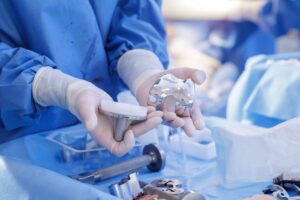
Once significant femoral head collapse has occurred, and the joint cartilage is destroyed, total hip replacement — also called total hip arthroplasty — is the most reliable surgical option. It replaces the affected femoral head and acetabulum (hip socket) with prosthetic components, eliminating pain and restoring function.
Who Is a Candidate for AVN Hip Replacement?
AVN hip replacement is typically recommended when:
- The femoral head has collapsed significantly (Stage 3–4)
- The joint cartilage is severely damaged, and the hip is functionally compromised
- Non-surgical treatment and joint-preserving surgery have failed or are no longer viable
- Pain is severe and significantly limiting daily activities
- The patient is medically fit for major surgery
Patient age considerations:
AVN commonly affects patients in their 30s, 40s, and 50s — which is younger than the typical hip replacement demographic. In younger patients, surgeons may attempt joint-preserving procedures first to delay hip replacement. However, when collapse is advanced and the joint is destroyed, replacement is often the most appropriate path regardless of age.
Patients who may not be immediate candidates:
Those with active joint infection, very poor overall health making anaesthesia high-risk, or very early-stage AVN where joint-preserving options are still viable will be assessed individually with a full clinical evaluation before replacement is recommended.
How Is AVN Hip Replacement Performed?
AVN hip replacement follows the same fundamental steps as hip replacement for arthritis — with some specific technical considerations related to the bone quality changes that AVN causes.
Step 1 — Anaesthesia
The procedure is performed under spinal or general anaesthesia. Your anaesthetist will advise the most appropriate option based on your overall health.
Step 2 — Surgical approach
The surgeon accesses the hip joint through a posterolateral or anterior approach. The specific approach affects post-operative precautions and rehabilitation.
Step 3 — Removing the damaged femoral head
The collapsed, damaged femoral head is removed. In AVN cases, the quality of the remaining femoral neck bone is carefully assessed — this influences implant selection and fixation strategy.
Step 4 — Implant selection and fixation
- In younger AVN patients with good bone quality, uncemented (cementless) fixation is typically preferred — the porous implant surface allows bone to grow in for long-term stability
- In older patients or those with compromised bone quality from steroid-related AVN, cemented fixation or hybrid fixation may produce more reliable results
- The acetabulum is prepared, and a new socket is implanted
- A femoral stem is placed into the femoral canal
Step 5 — Wound closure and immediate recovery
The hip joint is repositioned, the wound closed, and physiotherapy begins the same day or the following morning.
What to Expect After AVN Hip Replacement
Recovery from AVN hip replacement follows the same general pathway as hip replacement for other indications — with outcomes that are typically excellent when performed at the appropriate stage.
Day of surgery to Day 3: Most patients stand and take first steps with assistance the same day as surgery or the morning after. Pain is actively managed. Early physiotherapy focuses on preventing clots and beginning gentle hip mobilisation.
Week 1–2: Discharge home typically occurs within 3–5 days. Walking with a frame progresses to crutches. Basic independence with everyday activities is the primary goal.
Week 3–6: Transition to a cane. Stair climbing, short outdoor walks, and light daily activities resume. Most patients describe dramatically reduced pain compared to their pre-operative state.
Month 2–3: Cane is typically discontinued. Driving resumes around 6–8 weeks for most patients (confirm with your surgeon). Physiotherapy focuses on hip strength, balance, and functional movement.
Month 3–6: Full functional recovery for most daily activities. Return to low-impact recreational activities as cleared by your surgeon.
Long-term outcomes:
Studies consistently show that total hip replacement for AVN produces outcomes comparable to hip replacement for osteoarthritis — with implant survival rates of 90% or more at 10 years in most series. Younger age at implantation means the joint may need revision in later decades, which is factored into long-term surgical planning.
Frequently Asked Questions
1. Can stage 2 AVN be cured without surgery?
Stage 2 AVN may sometimes be managed with activity modification and medication, especially when the affected area is small. However, core decompression can offer better outcomes before bone collapse. Expert evaluation is important to choose the right treatment.
2. What is the success rate of AVN hip replacement surgery?
Total hip replacement for AVN generally provides excellent pain relief and function, with many studies reporting implant survival of 90% or more at 10 years. Outcomes are generally comparable to hip replacement for osteoarthritis.
3. How serious is Hip AVN?
Hip AVN can progressively damage the femoral head and lead to joint collapse, severe pain, and reduced mobility. However, early and timely treatment can significantly improve the prognosis and help preserve hip function.
4. What is the best treatment for AVN of the hip?
Treatment depends on the disease stage. Core decompression is commonly considered for Stage 1–2 AVN before collapse, while total hip replacement is generally recommended for advanced Stage 3–4 disease with significant joint damage.
5. How long can you live with avascular necrosis of the hip?
AVN does not usually affect life expectancy, but it can significantly affect mobility and quality of life. With appropriate treatment, patients can often return to an active, pain-free life. Early evaluation helps prevent further joint damage.
Conclusion — Taking the Next Step with AVN
AVN of the hip is a serious condition — but it is one that responds well to timely, appropriate treatment. The stage at which you seek care determines how many options are available to you. Early diagnosis preserves choices. Advanced collapse makes hip replacement the clearest and most reliable path to a pain-free life.
Dr. Bharat Goswami — a leading orthopaedic surgeon in Greater Noida at Fortis Hospital — brings specialised experience in the surgical management of avascular necrosis, including both joint-preserving procedures and total hip replacement. With a patient-first approach, meticulous surgical technique, and access to modern and precise implant systems, Dr. Goswami helps AVN patients at every stage regain their mobility and quality of life.