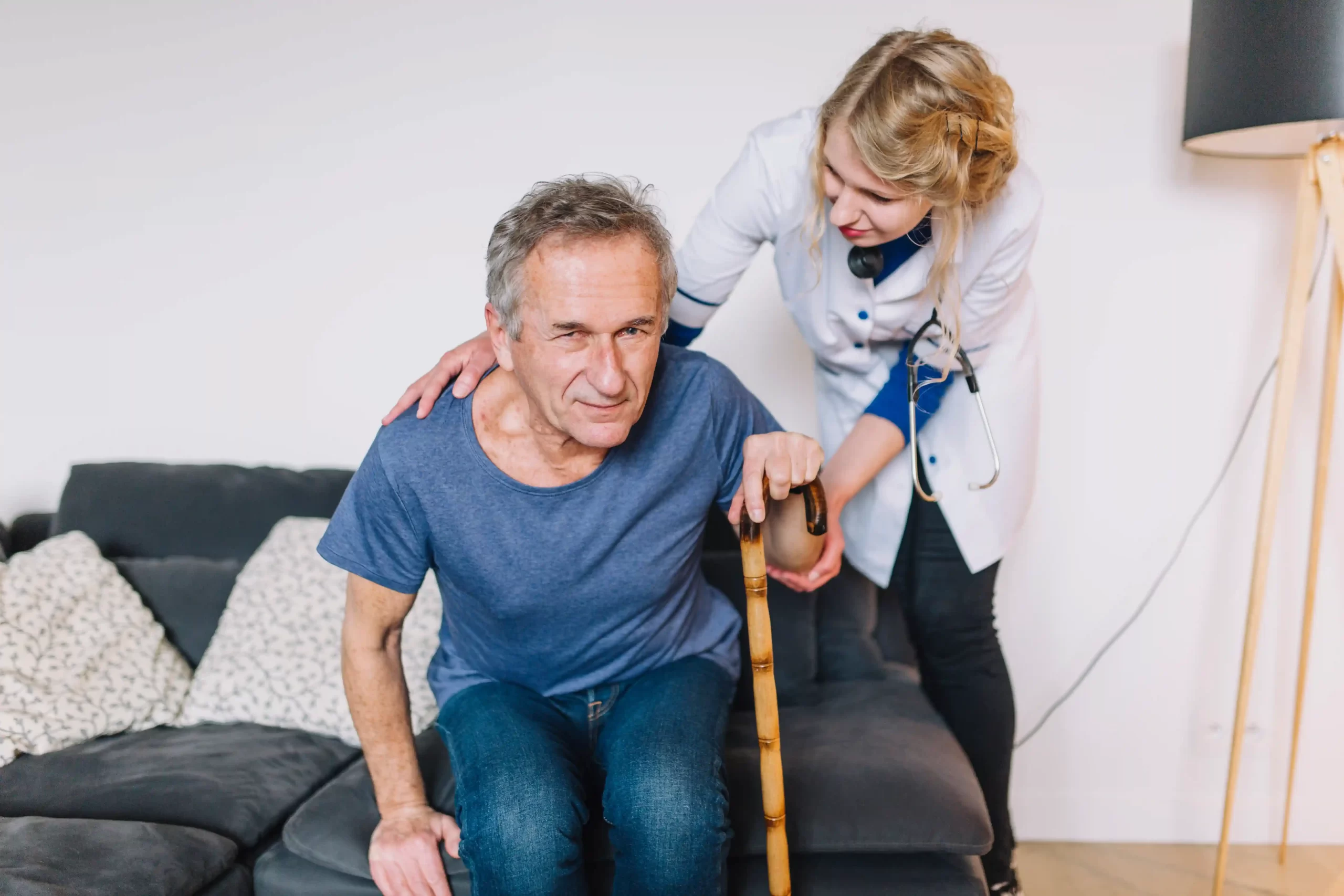
Knee replacement surgery is one of the most effective treatments for relieving severe knee pain and improving mobility in older adults. However, many patients wonder about the Knee Replacement Recovery Time for Elderly before deciding on surgery.
The Knee Replacement Recovery Time for Elderly varies depending on several factors such as age, overall health, the type of surgery, and how well rehabilitation is followed. While most seniors start walking within a day or two, complete recovery takes time.
In this complete guide, you’ll learn about the complete recovery timeline, factors that influence healing, recovery tips, possible risks, and what elderly patients can expect after knee replacement surgery.
Table of Contents
Why Knee Replacement Is Often Suggested for Elderly Patients
Knee osteoarthritis is progressive and disproportionately affects adults over 60. When conservative measures — physiotherapy, injections, anti-inflammatory medications — stop providing meaningful relief, total knee replacement (TKR) becomes the most effective long-term solution for restoring mobility and eliminating chronic joint pain.
For elderly patients specifically, the decision is often urgent rather than elective. Constant pain leads to reduced mobility, muscle deconditioning, fall risk, and downstream complications, including cardiovascular decline. Timely surgery frequently produces a better overall health outcome than continued conservative management in advanced cases.
What Is the Knee Replacement Recovery Time for Elderly Patients?
The honest answer: it is longer than for younger patients — but the final outcome is comparable when the right support structures are in place.
General recovery milestones for elderly patients (65+):
| Phase | Timeframe | Key Milestone |
| Acute hospital recovery | Day 0 – 3 | Pain management, first standing and walking |
| Early post-operative | Week 1 – 2 | Discharge, wound care, gentle ROM exercises |
| Sub-acute recovery | Week 3 – 6 | Physiotherapy, stair climbing, reduced walker use |
| Functional recovery | Month 2 – 3 | Independent walking, reduced pain medication |
| Active rehabilitation | Month 3 – 6 | Strength building, return to daily activities |
| Full recovery | Month 9 – 12 | Complete strength, range of motion, and implant settling |
Elderly patients frequently take 4 to 6 weeks longer to reach each milestone compared to patients under 55 — but achieving independence and pain relief within 6 months remains realistic for most.
Knee Replacement Recovery Timeline for Seniors — Week by Week
Week 1-2: The Most Demanding Phase
This is where elderly patients need the most support. Pain is highest, and mobility is most limited. Key activities include:
- Supervised walking with a walker within 24 hours of surgery
- Ankle pumping exercises to prevent DVT (deep vein thrombosis)
- Ice and elevation to manage post-operative swelling
- Strict medication management for pain and blood clot prevention
Week 3-6: Physiotherapy Becomes Central
Active physiotherapy typically begins in week 2-3. For seniors, this phase is crucial — the exercises must be progressed carefully to avoid overload on the joint while preventing stiffness:
- Quad sets, straight leg raises, heel slides
- Transition from walker to cane as strength improves
- Range of motion targets: 90 degrees of knee flexion by week 6
- Stair navigation introduced under therapist supervision
Month 2-3: Regaining Independence
Most elderly patients reach a meaningful independence threshold within this window:
- Walking without aids for short distances
- Managing light daily activities — cooking, personal hygiene, moving around the home
- Outpatient physiotherapy continuing 2-3 times per week
- Driving clearance (for the operated leg) is typically between weeks 6 and 8
Knee Replacement Recovery for a 70-Year-Old Woman
Women aged 70+ are among the largest groups undergoing knee replacement globally. Recovery dynamics in this cohort are shaped by specific physiological factors:
- Osteoporosis prevalence — reduces bone density around the implant, slowing osseointegration and increasing fracture risk
- Lower baseline muscle mass — sarcopenia means quadriceps rehabilitation takes longer and requires more intensive input
- Higher pain sensitivity — documented hormonal and neurological differences in pain processing after menopause
- Comorbidities — hypertension, diabetes, and cardiac conditions require coordinated peri-operative management
Adjusted timeline for a 70-year-old woman:
- Hospital stay: 3-5 days (vs 2-3 days for younger patients)
- Walker use: typically 4-6 weeks (vs 2-4 weeks)
- Functional independence: 3-4 months
- Full recovery: 10-14 months
Risks of Knee Replacement Surgery in the Elderly
Informed consent for elderly patients requires honest risk communication. Frequency of complications increases with age, comorbidity burden, and frailty score:
- DVT / Pulmonary Embolism — the most serious immediate risk; managed with anticoagulation and early mobilisation
- Surgical site infection — higher risk in diabetic and immunocompromised elderly patients; managed with antibiotic prophylaxis
- Implant loosening — lower activity levels in elderly patients actually reduce mechanical stress on the implant, decreasing this risk
- Post-operative delirium — occurs in 10-15% of elderly surgical patients; managed with careful anaesthesia selection and early mobilisation
- Stiffness / Arthrofibrosis — inadequate early mobilisation increases scar tissue formation; physiotherapy compliance is critical
- Cardiac events — cardiac screening pre-operatively is essential for patients over 70
Factors That Influence Recovery in Elderly Patients
These variables directly determine whether an elderly patient falls in the faster or slower recovery cohort:
Positive predictors:
- Higher pre-operative functional status and activity level
- Good nutritional status — adequate protein intake supports tissue healing
- Absence of uncontrolled diabetes or cardiac conditions
- Strong social support at home
- Early surgery before significant muscle wasting occurs
Factors that slow recovery:
- BMI above 35 — increases mechanical load and anaesthetic risk
- Pre-existing sarcopenia — delays quad strength return
- Poor pre-operative range of motion — suggests existing joint stiffness that persists post-surgery
- Cognitive decline — reduces physiotherapy compliance and self-management capacity
- Living alone without family support during the acute recovery phase
How Long Does Knee Replacement Recovery Take in Seniors?
Standard recovery track (most elderly patients):
Full independence at 3-6 months, complete recovery at 12 months.
Fast recovery track (fit, active seniors with good pre-operative function):
Independence at 6-8 weeks, near-complete recovery by 4-6 months.
Slow recovery track (frail elderly with comorbidities):
Independence at 6-9 months, complete recovery timeline extending to 14-18 months. Still worthwhile — studies confirm 90%+ satisfaction rates even in this cohort.
What Is the Fastest Way to Recover from a Knee Replacement?
For elderly patients, the fastest recovery pathway involves combining medical optimisation with behavioural and nutritional strategies:
Pre-operatively:
- Prehabilitation — building quad and hip strength before surgery consistently reduces post-operative recovery time
- Nutritional optimisation — protein intake of 1.2-1.5g per kg body weight supports surgical healing
- Smoking cessation — reduces complication risk and improves wound healing
- Diabetes and blood pressure optimisation — targeted pre-op HbA1c below 7.5 reduces infection risk
Post-operatively:
- Cryotherapy — consistent icing in the first 3 weeks reduces swelling and pain medication dependence
- Formal physiotherapy at a dedicated rehabilitation centre rather than home exercises alone
- Compliance with blood thinner medication — prevents DVT, which can delay the entire recovery
- Progressive weight-bearing as directed — avoiding both too much and too little activity
Tips That May Support Smoother Recovery for Elderly Patients
- Prepare the home before surgery — remove trip hazards, install grab rails in the bathroom, arrange ground-floor sleeping if stairs are an issue
- Nutrition matters significantly — Vitamin D, calcium, and protein intake all directly affect bone healing and muscle recovery in elderly patients
- Sleep positioning — back sleeping with a pillow under the calf (not the knee) reduces flexion contracture risk
- Mental health support — anxiety and depression significantly slow recovery in elderly surgical patients; address proactively
- Compression stockings — worn as directed reduce swelling and DVT risk during the first 6 weeks
Follow-Up Care After Knee Replacement in Elderly Patients
A structured follow-up protocol is non-negotiable for elderly patients:
- Week 2 — wound review, suture or staple removal, range of motion assessment
- Week 6 — X-ray to confirm implant positioning, physiotherapy progression review
- Month 3 — functional assessment, strength testing, gait analysis
- Month 6 — range of motion measurement, patient-reported outcome scores
- Year 1 — comprehensive review, implant imaging, long-term activity guidance
Missed follow-up appointments in elderly patients are associated with higher rates of late complications — emphasise this to family caregivers.
Frequently Asked Questions
1. What is the recovery time for a 70-year-old after knee replacement?
Most 70-year-old patients achieve functional independence within 3-5 months and near-complete recovery within 10-14 months. With prehabilitation, good nutrition, and consistent physiotherapy, some reach independence milestones as early as 8-10 weeks.
2. Should an 80-year-old have knee surgery?
Age alone does not disqualify a patient from knee replacement. Surgical decision-making for octogenarians is based on functional status, comorbidity burden, and frailty score — not chronological age. Many 80+ patients achieve excellent outcomes with appropriate peri-operative management.
3. How painful is a knee replacement on a scale of 1 to 10?
Most elderly patients report post-operative pain between 5 and 7 in the first week, reducing to 2-3 by week 4 with medication and physiotherapy. By month 3, most patients report their pain level is lower than their pre-operative chronic joint pain.
4. What is the fastest way to recover from a total knee replacement?
Prehabilitation before surgery, protein-rich nutrition, consistent physiotherapy starting within 24 hours, cryotherapy, and strict DVT prevention protocols collectively produce the fastest recovery trajectory. Skipping any element delays the overall timeline.
5. How long until you walk normally after a total knee replacement?
Most elderly patients walk without an aid at approximately 6-10 weeks, though gait normalisation — eliminating the antalgic limp — typically takes 3-6 months. Full, confident walking for extended distances is usually achieved by 4-6 months.
Conclusion
Knee replacement recovery time for elderly patients is longer than for younger adults, but the outcome — sustained pain relief, restored mobility, and improved quality of life — is just as achievable. Age alone is not a contraindication. With proper pre-operative optimisation, evidence-based peri-operative care, and consistent rehabilitation, patients well into their 70s and 80s achieve excellent surgical results.
Dr. Bharat Goswami — Best Orthopedic Surgeon in Greater Noida — at Fortis Hospital, Greater Noida, specialises in knee replacement surgery for elderly patients with complex comorbidities. His approach combines pre-operative optimisation, minimally invasive implant techniques, and a structured geriatric rehabilitation protocol to maximise outcomes in this high-need population.